

A lot of founders are using AI for their personal brand, but they all end up doing different versions of the same thing.
They open Claude, type something like “Write me a post about [topic]”, read back what comes out, and start tweaking. Then they reprompt.
With each iteration, the prompt degrades a little, and the output does the same.
What started as trying to write one post turns into a 60+ minute loop, ending with something they still have to rewrite themselves anyway.
The real problem is that they have a context issue that they’re trying to solve with better prompting. They’re outsourcing the thinking that should have built the foundation of their personal brand. There’s no positioning, no narrative captured, and they’re not really clear on their ICP. They think they are, but its surface level stuff.
Claude as it is, “out of the box”, knows what a run-of-the-mill “founder” sounds like. It’s absorbed millions of founder posts, business books, and everything else “founder” branded on the internet. So when you give it a vague brief, it produces a mash-up of all of those.
There’s no magic prompt to fix this. Prompts are instructions, not your identity. You can tell Claude to be direct and specific, but it doesn’t know what “direct and specific” means in your voice or using your methodologies.
Asking for better output without giving better input is like asking a new hire to represent you in a pitch meeting an hour after they joined.
The effort doesn’t matter when the context isn’t there.
📌Quick distinction:
Context isn’t a voice guide you fill in once. It refers to your real-life vocabulary, your stories, your specific methodology, and your worldview. Once you have an idea of what these are, you can load them into your personal operating system so the AI knows who you really are.
What’s Happening in the Feed
Go ahead and spend 5 minutes on LinkedIn today and count how many posts feel like they could have been written by anyone. Not just AI-assisted posts, but posts where there’s zero identifiable perspective and no specific experience behind the claims made.
Sure, a lot of these posts might be well-structured and sound decent, but they could be attributed to any founder in any industry. There’s no identity.
The founders who stand out are those who have really given their AI something to work with. A real foundation of their voice, positioning, experience, and proof of that experience.
That gets built into a system that uses the same foundation every time they produce new content.
That’s what a Personal Brand AI Operating System is.
An OS Raises Information Density
A well-built OS produces denser content, built on real frameworks and with the weight of specific experience behind every claim.
It uses ideas that can’t be replicated because they come from your methodology and your Story Bank, not from Claude’s general understanding of generic founder knowledge.
Generic posts = generic results.
Your OS raises information density because it builds from real material. Your material.
💡Worth knowing
Information density is the best indicator of whether a personal brand is building real authority or just generating activity.
A post with a proprietary framework and a specific proof point will outperform a post with borrowed ideas and vague mentions of experience with no proof every time.
What the OS Produces
Stronger, more unique ideas:
The process of naming your frameworks and stress-testing them forces a level of intellectual clarity that’s never articulated. The OS brings up connections across your work that you might not have made on your own.
Sharper methodology your ICP understands:
When you’re forced to articulate your methodology clearly enough to publish it week after week, it becomes something your prospects already understand when they approach you.
Framework density:
By month 6, there’s a growing library of named, proprietary frameworks and IP that you own. These are reusable concepts that move out of your content and into your business. Content production is significantly quicker and the information density is significantly higher. Your frameworks will come up in sales calls, proposals, internal comms, and product decisions.
The Difference Between a Claude Project and a Personal Brand AI OS
If you’ve got a Claude project with a knowledge base, like a voice guide and a few sample posts, you’re likely already getting better output and less generic content.
But you’re still getting 5-10 likes and less than 500 impressions on every post.
Because that’s not an OS.
The biggest functional difference between a Claude project and an OS is memory + context.
You can dump all your brand files into a Claude knowledge base. The problem is they all sit in a flat hierarchy, with no structure and no routing. Every task reads everything (your Voice Card, ICP, Story Bank, and positioning), whether they’re relevant or not.
That’s the problem. Claude’s output quality degrades the more context you load in. It’s helpful at 5 files, but it’s working against you at 20. (not 100% true, but just making a point)
An OS routes instead of dumps. The Claude.md file tells Claude which files to read for which task.
Writing a LinkedIn post? It loads your voice and ICP.
Updating your Story Bank? It loads the story format only.
Context has a purpose. It’s never just a dump of information.
The knowledge base holds onto what you uploaded when you set the project up. The AI doesn’t know what’s changed since then, though, since it can’t self-learn.
Context you share inside a session, like a correction you made mid-draft or a new insight that came up, doesn’t get stored in the knowledge base. When you close the window, it’s gone, and the next session will start from whatever was in the project files before.
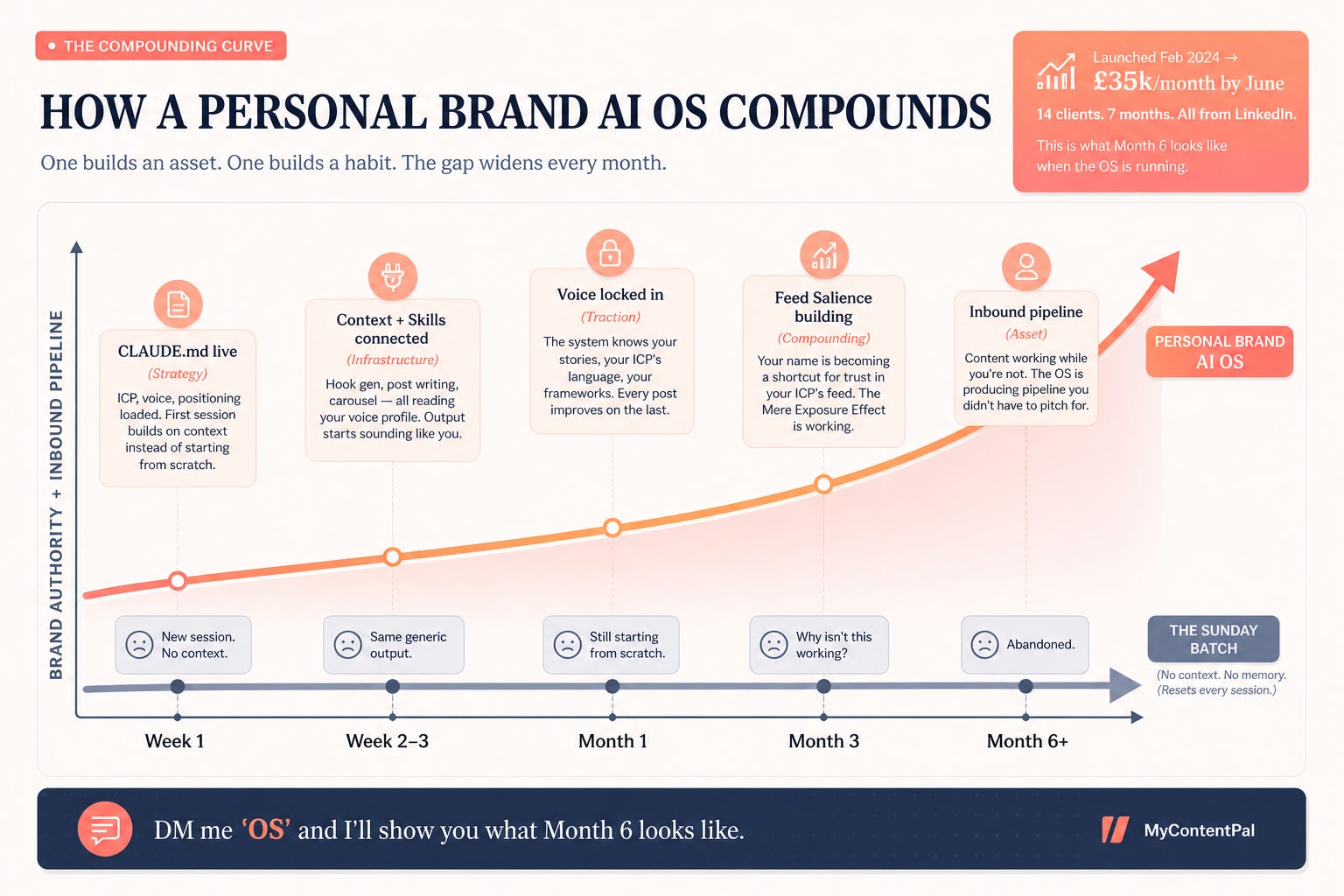
As a result, month 6 of a Claude project looks pretty much identical to month 1.
The system has no record of what posts you’ve published, what landed, what flopped, what your audience responded to, or what you’ve decided to stop saying. You’re essentially starting from scratch every time.
An OS compounds by improving after every piece of input it gets.
Every post that goes out gets archived with performance data attached to it, and every correction you make to a draft gets written into the Memory. Every call transcript that comes in adds to your Story Bank, and your Voice Card sharpens with each version of a post.
By month 6, your system will know more about your personal brand than you consciously store in your head at any given moment.
The Anatomy of a Personal Brand AI OS
A Personal Brand AI OS isn’t a single folder of files. There are 10 distinct parts to it, each with a specific job, plus the external systems it reads from and writes to.
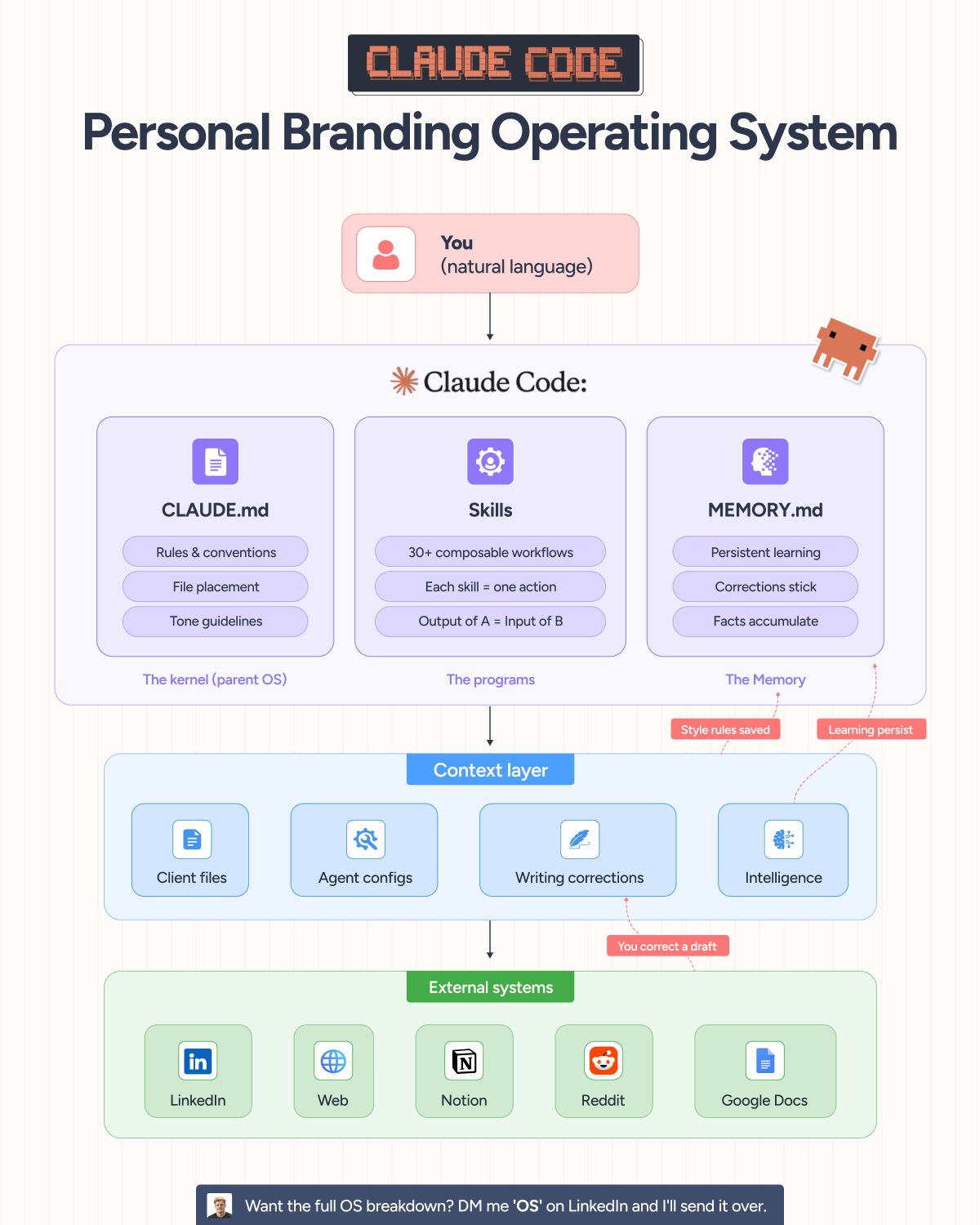
1. CLAUDE.md: The rules file
Every action your OS takes will start here.
Claude.md is read before every task the AI runs. It doesn’t store your brand information; it routes Claude to the right files for each job.
Dumping everything into one flat knowledge base means Claude wades through all of it every time you prompt it. But quality degrades as that pile grows.
Claude.md solves that by making sure the AI only reads what it needs, when it needs it.
Without it, every action starts with Claude guessing what you need.
With it, every action it takes is already pointed at the right context.
2. Context
Context is the most important layer of your OS and the one that does the most work. It’s everything that makes your personal brand specifically yours, i.e, the stuff that can’t be copied and pasted into another OS without it producing the wrong output.
🗣️ Voice
Your voice is your actual vocabulary.
So rather than saying “I want a post that sounds direct and conversational” (which means nothing to an AI), your OS will use your exact voice to flesh out your sentence rhythm and the phrases you use most often.
You can build this from real writing samples, recorded voice notes, speech patterns, and podcast clips rather than a one-page brief on language that vaguely resembles how you speak.
👥 Ideal Customer Profile (ICP)
Your ICP is a precise model of who you’re talking to.
Instead of targeting a demographic of people, you need to have a specific person in a specific state of awareness with specific language for their problems in mind.
The ICP file tells your OS who to write for and what they care about, which means it knows what the content needs to do in order to get your ICP to take action.
🏦 Story Bank
This is the material behind the claims you make.
Every founder has a handful of useful stories to tell, like the failure that taught them something they’d never read in a business book or a client result that proved their methodology.
The Story Bank captures each of these properly so the AI can draw on real proof rather than producing false, over-exaggerated, or generic posts about your “experience” that your readers will know aren’t real.
🌏 Narrative Deck
Your Narrative Deck is your worldview.
The beliefs or ideas you have about your industry that other people in your space aren’t talking about, and your contrarian takes.
These are the kinds of positions you take or things you decide after spending years in the industry, not something you come up with overnight.
It creates a real, developed viewpoint instead of just throwing another opinion out into an already overcrowded platform.
🧍Positioning
Positioning is where you sit in the market.
Who you serve, who you don’t, what you’re the best option for, what you’re not.
There are 10,000+ ghostwriters. How many are speaking about building a Personal Brand AI OS? Me? Maybe a couple more?
The clearer this is inside your OS, the more every piece of content it produces does double the work.
It builds authority with the right people and disqualifies the wrong people all in one go.
📋 Operating Standards
These are the guardrails, like banned phrases and formatting rules.
They exist so your brand doesn’t drift over time as you make slightly different decisions in different sessions with your OS.
Even when you step outside of your usual set of rules for a specific outlier post, your next one will still follow the same standards that your ICP knows you for.
3. Intelligence
Context is brand-specific. It’s about you. But intelligence is about how personal branding works.
It’s the methodology that’s embedded in the system and applies to every Skill and Playbook you own that runs inside your OS.
This changes the AI from producing content in your voice to producing content that understands what the content is supposed to achieve.
The Intelligence aspect is the same across every OS we build. It’s why a well-built OS produces better results from a jumbled folder of brand files being dumped into a Claude project.
You can have the most accurate Voice Card in the world and still produce generic content if the AI doesn’t understand what it’s supposed to accomplish.
Intelligence is what gives it that understanding.
There are a few frameworks that work inside this layer:
KLTB maps out how audiences move from discovering your personal brand to buying from it.
Know → Like → Trust → Buy
Every piece of content fits somewhere in that buying journey. When your OS knows how to use this, it produces content that does the right job at the right stage rather than giving you content at the same pitch level.
Feed Salience is how you measure whether your personal branding is working. It encompasses whether the right people (the specific founders and decision-makers in your ICP) stop scrolling when your name appears in their feed.
Narrative Arc is the quarterly strategy. It includes what thesis is being pushed, which proof points go in which sequence, and how the content builds to a coherent argument over time rather than producing disconnected posts that go nowhere. Without a Narrative Arc, you’re posting a lot and just creating noise. This helps to narrow everything down into a case.
Hook Mechanics is the framework for the opening lines of your posts. They’re the specific structures that help you to earn attention from a cold audience using patterns that stop the scroll and avoid the mistakes that cause people to keep moving.
When you’re posting faster than quality can keep up with or producing content that’s too thin, you’re putting in more effort while your results are going down. This is the Content Vacuum. Your OS should be designed to catch this kind of pattern rather than just optimising your posts for output.
The Approval Process. You write the brief and approve the output. AI handles production, but the taste and thinking belong to you. The moment a reader can tell a machine wrote your content, trust drops.
Source Extraction is how you pull original thinking from your own calls, voice notes, wins, and losses, so the content is built from real material instead of Claude’s general sense of what founders are supposed to believe.
4. Skills
Skills are the verbs of your OS.
Each one has one job to do, like writing a hook or stripping each draft of your post of AI-isms.
Skills also build up on one another, since the output of one feeds directly into the next. Each Skill does one job deliberately.
When a Skill needs updating, you can change one file, and the whole system picks it up. You don’t have to rebuild a prompt every time something needs to change.
5. Playbooks
If Skills are individual actions your OS takes, Playbooks are sequences of these actions.
They chain the Skills together into a full end-to-end sequence for a specific content type, whether it’s LinkedIn posts, newsletters, or anything else that needs to be produced.
Each step feeds into the next, and the whole thing runs automatically from a single brief at the start of the session.
6. Workflows
Playbooks tell the AI what to do, while Workflows tell the human what to do.
No matter who is running your OS, they need to follow the process docs or the Workflow. This includes the approval process that every draft needs to pass through within the publishing handoff checklist.
Systems that mix Playbooks and Workflows up usually end up delegating important judgment calls to the AI, which drops operational details that need a human touch.
7. Memory
Memory is where a Claude project turns into a Personal Branding AI OS.
It tracks 3 things:
Corrections made to drafts
Patterns that produced strong results
Patterns that flopped
The corrections help to capture any voice rules that pop up through feedback or specific guidance that was given every time a draft was changed.
For instance, when you say “Never open with a statistic” or “Always name the framework”, these changes live in your OS permanently so that the AI doesn’t unlearn them after every session.
The patterns tell the AI what’s working based on the feedback it gets after a post is published. If a certain structure meant you got the right type of engagement or a specific story type helped to generate more DMs, the AI will lean into them.
The AI also learns from what didn’t work, like content types that look good on paper but end up doing nothing for your business.
Without Memory, every session you have starts fresh.
That means the corrections you made last week aren’t being implemented this week, and patterns your AI learned in month 2 aren’t guiding your content in month 5. So, your OS can produce content, but it can never improve.
8. The production queue
The production queue, or the Brief layer of your OS, is there to prevent half-baked ideas from turning into half-baked posts.
You can’t go straight from an idea to a prompt. A half-formed thought doesn’t turn into a strong post just because it gets typed into Claude.
In the production queue, every idea gets captured first, whether as a voice note after a call or a DM question worth answering publicly. Then it gets developed into a proper Post Brief before anything gets produced.
A Post Brief tells the AI the angle, the audience, the proof point, the framework it needs to use, and what the post is supposed to do (generate a DM, build authority with a specific ICP, etc.).
So while a prompt is an instruction, a Brief gives the AI something to work with to produce better output for your ICP.
9. Output
Everything that gets published gets filed in the Output folder by week, with the performance data attached. This gives your AI a record of what your brand has already published.
Output also feeds directly into Memory.
The end-of-week review reads exactly what went out and when and identifies what worked and why.
Those insights are absorbed by the Memory, so the system keeps learning what works and what doesn’t, without you having to tell it manually.
10. Sync
Sync keeps your OS up-to-date without requiring you to manually update everything.
It pulls ideas and articles you’ve tagged during the week, and pulls call transcripts and formats them for Story Bank updates. That way, real material from your sales conversations and client calls doesn’t stay locked in a recording that nobody goes back to listen to.
Without Sync, your OS will only ever know what someone has typed in. But when it’s added to the Context layer, it continuously takes in information from your personal brand to get better over time.
How to Build Your Personal Brand AI OS
Instead of trying to build all 10 parts of your Personal Brand AI OS at once, focus on the 3 files you need to get started:
Context
Intelligence
Claude.md
Everything else will build as your system runs.
Step 1: Set up your Personal Brand OS folder
Create a folder called “personal-brand-os” or something similar, then open it in Claude Code or AI Content Pal.
That’s your OS, and every file you build from here will live inside it. The operating model or harness reads from this folder every time it runs, so whatever you put in here is what the AI works from.
Step 2: Build your Voice Card (Week 1)
This is the most important file in the OS. Everything else is useless if this is wrong.
Writing something about how you’d like to sound (“Direct. Conversational. No corporate jargon.”) means nothing to an AI.
You need to give it raw material.
Pull 10-15 posts you’ve written that felt like you and copy them in.
Record 5-10 minutes of yourself talking through a client problem using the same language you’d use in a client call. Transcribe it.
Pull 5 DMs or email threads where you were writing without thinking too hard about what you sounded like.
Dump it all into a document and ask the AI to:
“Analyse everything here. Identify my sentence rhythm, the phrases I use often, how I structure an argument, how I open and close a point, my default level of formality, and any patterns that show up across multiple samples. Using this, build me a Voice Card that’s specific enough for another writer to reproduce it.”
Then test it. Ask the AI to write a short post about something you know really well.
If you’d need to rewrite more than 20% of it, the Voice Card needs more raw material.
Keep feeding it samples until the output needs as little correction as possible.
💡Your Voice Card is never really “finished”. It gets sharper every time you make a correction. But it does need to be functional before you start producing content with your OS.
Step 3: Fill the Story Bank (Week 1)
If you rush this, you’ll end up with summaries. Summaries are useless.
Go through your sales calls, client wins, failures, pricing decisions, hiring mistakes, and even breakthroughs you’ve had. Build 10-15 stories before trying to produce any content.
Without a deep Story Bank, every post is going to rely on the AI’s general idea of what a founder’s experience looks like.
A usable story has 4 things:
What was happening (specific context)
What occurred (the event)
What it produced (a concrete result)
What it means (the framework or belief it created)
❎ An unusable story
“I once took on a client I knew wasn’t right for my business, and it nearly destroyed the team.”
This is too vague and gives your AI nothing to work from.
“Once” doesn’t tell it the when.
Why wasn’t the client right?
Why did you take the client on?
How did it nearly destroy your team?
📖 A usable story
“We signed a £ 12k/month client in 2022 because the cash looked good. Their brief changed 3 times in the first month. In week 6, two of our best people were threatening to quit. We parted ways with the client in month 4 and refunded £8k. We wrote our ‘no misaligned clients’ rule that week [explanation of the rule]. It’s the reason we turn away around 1 in 4 inbound leads now.”
This version of the same story could carry an entire post (or three) on its own. And it gives your AI more context, more understanding of how you think, more knowledge of your brand, and a framework it can reference in future posts.
Step 4: Write your ICP file as a real person (Week 1)
An ICP isn’t “Founders with £1-5M revenue, 5-20 employees, professional services.”
The format that works:
Who they are: A 42-year-old agency founder with £3M revenue. Team of 12. Bills at £1,200 per day. The business runs on their reputation, but she’s barely visible outside of her network.
What they’re trying to do: Build inbound so deals aren’t dependent on who they had lunch with last month.
What they’ve already tried: Posted on LinkedIn for 4 months. Got engagement from peers, but zero client interest. Hired a ghostwriter. Got posts that didn’t sound like them. Cancelled after 6 months.
What they believe about the problem: They need to post more consistently. LinkedIn doesn’t work for their business.
What they actually need to hear: Their foundation is wrong. They need a Personal Brand AI OS.
When the AI “knows” the person you’re targeting, it stops producing content for a vague audience and starts writing for someone specific enough. The right reader should think, “This is written for me.”
Step 5: Write Claude.md last (Week 2)
Starting with Claude.md seems like the logical thing to do. But Claude.md routes Claude to the right files for each task. If the files aren’t populated yet, there’s nothing to route to.
Once your Context is built, write a Claude.md that does 3 things:
Names the brand and ICP in one or two lines
Lists the rules (tone, formatting, what to avoid, etc)
Routes Claude to the right files for different jobs (For LinkedIn posts, read context/voice.md and context/icp.md first. For Story Bank updates, apply the four-part story format.)
Keep it short. This file is going to be read before every action, so it should be scannable in 30 seconds.
Step 6: Run your first brief (Week 2)
Don’t add the Intelligence layer or build skills just yet.
Take one real idea, like something you said on a call this week, and build it into a Post Brief manually. Include the angle, who it’s for, what proof backs it up, and what the post needs to do.
Run it through your OS with just the Voice Card and ICP loaded.
Read what comes back.
That’s your diagnostic.
If it sounds generic, the Voice Card needs more raw material.
If it makes the right argument in the wrong voice, the ICP is fine, but the Voice needs work.
If the argument itself is weak, the Story Bank doesn’t have enough specific proof yet.
The first brief tells you what to fix. If you build infrastructure on top of these layers, it’ll be harder to pinpoint if something isn’t working later.
Step 7: Add the Intelligence layer (Week 3)
Once your OS can produce a first draft that sounds roughly like you, load your methodology frameworks like the Narrative Arc and Hook Mechanics into the Intelligence folder.
These don’t need to be built from scratch. They come with the OS we build.
What matters is making sure Claude.md points to them at the right moments.
Playbooks reference Feed Salience when choosing angles or the Narrative Arc when you’re building a quarterly content plan.
This turns your system into something that produces content that adds to your business, in your voice.
Step 8: Skills and Playbooks (Week 4 onwards)
Skills and Playbooks are mostly inherited from My Content Pal’s library. But brand-specific add-ons are built as they’re needed.
Workflows get written once and updated when processes change.
Briefs, Output, Sync, and Memory start empty and fill up as your system runs.
These are the multipliers that enable your OS to compound. But if they’re added to an empty Context layer, they’re going to produce nothing worthwhile.
What the first month looks like
Week 1 is entirely spent on Context, with no content production.
It’s adding your Voice Card, ICP, Story Bank, and Positioning.
Week 2 is Claude.md and the first diagnostic briefs. Every correction you make to a draft goes straight into memory/corrections.md.
Week 3 is the Intelligence layer and the first Narrative Arc.
It’s the ideas you’ll be pushing and the frameworks you’ll end up naming this quarter.
Week 4 is your first production run from brief to published post. This is when your OS is live.
From here, one habit matters more than anything: the end-of-week review.
Read what went out and log what worked in patterns-that-work.md.
Log what flopped in patterns-that-flop.md.
Log every correction in corrections.md.
Your OS won’t automatically compound. Someone needs to run this review every week without exception. And, really, that’s the only discipline this system needs. Everything else is handled on its own.
The Operating Model
The Operating Model is the outside view of your OS, including who runs it, what it runs on, and how a piece of content moves from a rough idea to a published post.
The OS
Your OS is where your intellectual property (your voice, ICP, frameworks, memory, etc.) lives in a portable markdown.
The rest of the system depends on this, but it’s also the piece that most agencies never give you ownership of. That’s why the agency graveyard exists.
You spend 12 months with a ghostwriting team before cancelling the retainer and walking away with nothing to show for it except a folder of posts you can’t reproduce because the context that they came out of is in someone else’s head.
The Harness
The Harness is the interface that loads your OS.
AI Content Pal is built for teams, with a clean interface that’s designed for founders and operators who want to run the OS without needing to learn how to code.
Claude Code is great for more direct and technical work, and gives you maximum control. This is designed for founders who want to see exactly how the system runs and be able to change it themselves.
The Harness is swappable. So when better interfaces pop up (and they will), you can load your OS files into a new one.
That prevents your investment in building your own OS from depreciating when tools change, which is why the OS isn’t tied to one tool.
Your files move. The platform doesn’t matter.
The Operator
Someone still has to run it. A real human needs to take the brief, approve the output, and hit publish on a post.
Founders
This gives you high autonomy and full ownership of the process at the cost of around 2-3 focused hours a week. It works well if you want to stay close to your content and treat it more like a strategic activity, and it’s viable long-term if you have the time.
Personal Branding Assistants (PBAs)
A PBA is a VA who is totally trained on the harness you’re using and on your OS. They run the system day-to-day and manage the production queue, from producing first drafts to presenting the work for approval.
You review and approve. The PBA handles everything else.
A done-for-you team
The team is fully outsourced. Once you approve your team, they run everything.
This is ideal when you’re billing at a rate where your time is literally too expensive to spend on production.
How content moves through the system
When content is produced, it moves through the three rings in a sequence.
The Operator takes the brief and names the angle, the audience, the proof point, and the format. It gets developed into a Post Brief and queued for production.
Then, the Harness loads your OS. Your system reads the instructions, pulls the relevant Context files, checks the Memory for applicable corrections and patterns, and runs the matching Playbook. That’s when it produces a first draft that matches your brand.
Lastly, the Operator reviews the content. They check for voice accuracy and cut anything off-brand. Once everything checks out, they approve and give it back to the Harness. The platform formats and routes the content, applying the necessary formatting before publishing it or handing the file back for scheduling.
The output gets filed, and the end-of-week review updates the Memory.
Your system keeps learning your brand with every draft, and the quality will keep improving post after post as a result.
What Progress Looks Like
The real measure of whether a Personal Brand AI OS is working is how sharp the layer underneath your content is getting.
Can your PB AI OS produce a first draft that sounds like you without a full rewrite?
If every draft still needs a lot of work before it’s usable, the Voice Card isn’t landing correctly.
Is the Story Bank full of specific, usable proof?
If it’s too vague about your experience, your stories aren’t specific enough to carry a post on their own or too abstract to use directly.
How many of your real sales-call objections have been turned into content?
How many frameworks have you named? Is the Narrative Arc for this quarter clear enough to create a brief from? If not, your AI OS can produce content, but it’s only working with half the picture.
All of these things compound, so a founder with 400 followers, a strong Voice Card, a deep Story Bank, and 8 named frameworks is in a better position than a founder with 4,000 followers and nothing to show for it.
2️⃣ The two-iteration rule
A calibrated PB AI OS produces drafts that are ready to be approved after 2 rounds of corrections or fewer.
If you’re still rewriting every draft from scratch, the Voice Card needs work before any more content is produced.
Stop Prompting. Start Building.
Personal branding depends on leverage.
The question is never “How do I produce more content?”
It’s “How do I build something that captures what I already have and turn it into the authority and the pipeline I don’t have time to manually build?”
A Personal Brand AI OS is an answer to that question.
Posting consistently is what comes out.
Personal branding is what goes in.
Your OS is the in.
If you’re ready to build your OS, there are two ways to do it with My Content Pal.
Build it yourself. If you want to build your own OS with the right methodology behind it, we have a course that walks you through each step, from Context to Memory.
You build it. You own it. You run it.
Have us build it for you. When your time is limited, our done-for-you service builds the full OS for you. Your Voice Card, ICP, Story Bank, Narrative Deck, and everything in between are in place and ready to run from day one.
You approve. We do the rest.
We’re looking for people to trial our new "with you" programme. If you want us to build your own Personal Brand AI OS, book a call with me here:
- Craig