

Here’s a jarring fact for you: the average person scrolls past 300 feet of content per day. Your post gets about 1.7 seconds to earn attention.
…and you opened with ‘I am thrilled to announce…’.
Or ‘In the ever-evolving digital landscape…’
Or ‘You don’t have a content problem…’
… and you have no idea why it didn’t pop off.
But you will by the end of this newsletter.
You might think that your B2B product is too boring to make interesting.
Here’s HARD PROOF from my clients that that’s wrong..
CLIENT A: Head of Ops at an agency. Industry: link building…
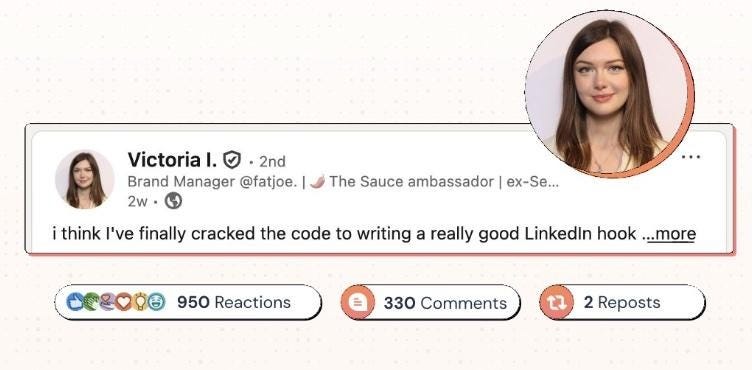
Before she came to us, she was making posts like this:
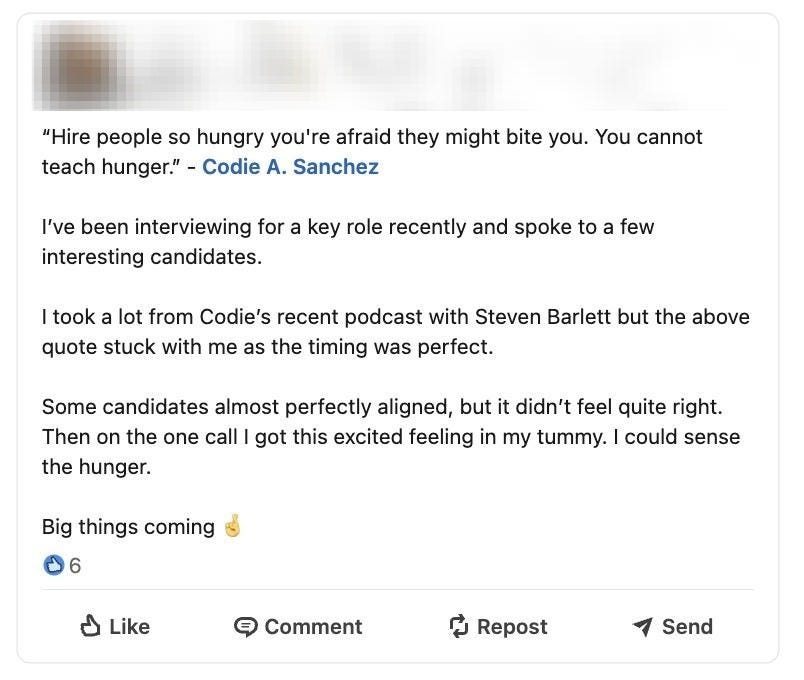
6 likes. One from her boss btw.
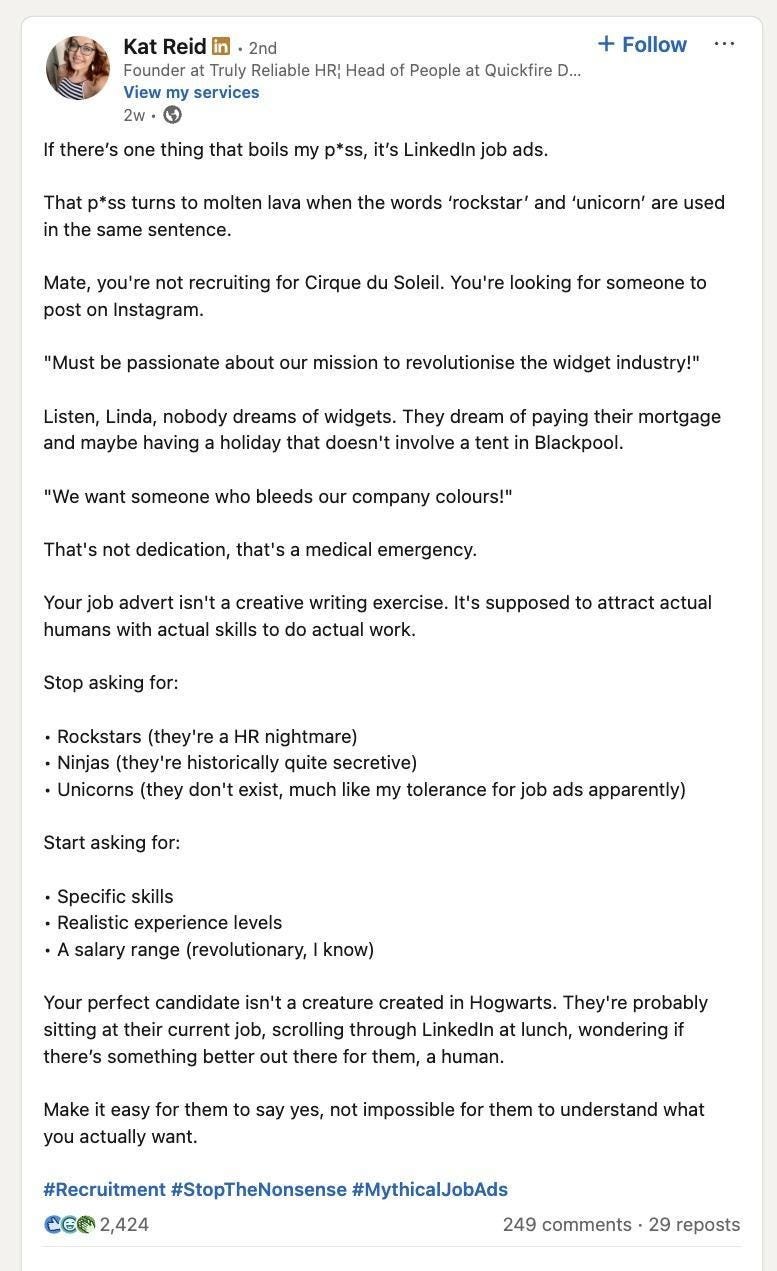
Then last week, we posted this for her:
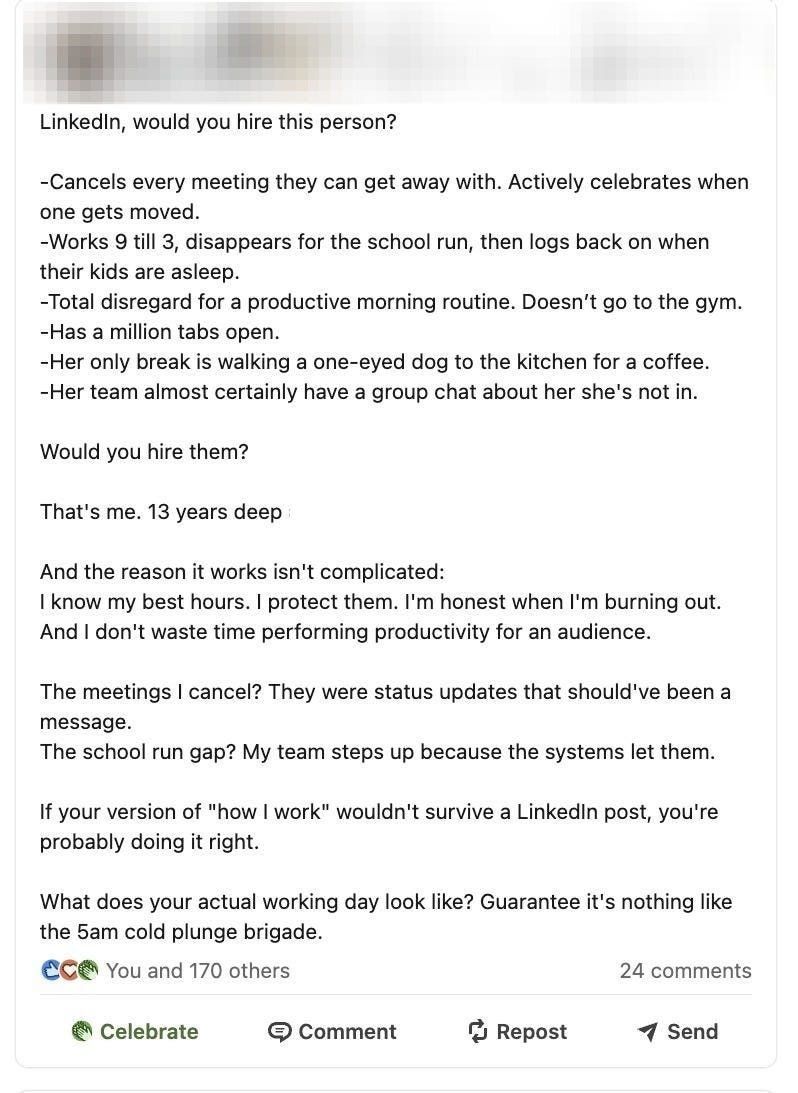
See the difference?
Same topic (hiring), same expertise. Different angle, wildly different results.
Why This Is Happening
In 1971, Nobel Prize-winning economist Herbert Simon put it this way: in an information-rich world, information consumes the attention of its recipients. Abundance of information doesn’t create abundance of understanding. It creates scarcity of attention.
^ 54 years ago btw. Before the internet. Before LinkedIn birthed the insufferable AI-slop thought-leader gurus. Before your competitor posted the same carousel template you did on the exact same Tuesday morning.
Now add this to the mess: since ChatGPT launched, AI-generated posts on LinkedIn have surged 189%. Over 54% of long-form LinkedIn posts are now estimated to be AI-generated. And AI-generated posts receive 45% less engagement than human-written ones.
Read that again.
More than half the content in your feed is machine-written. And it gets nearly half the engagement of real human content….
…yet everyone keeps milking lukewarm AI slop out of their robot slaves.
And now the feed is drowning in the stuff. It’s hollow, it’s soulless, it has 0 original data, no real opinions, no voice.
We’re greeted with a boring wall of “leveraging synergies” and “I’m thrilled to share” written by the same language model.
And all our brains are running a filter. Neuroscientists call it habituation - where the nervous system tunes out consistent, predictable stimuli. Same blue-and-white brand colors. Same Canva carousel. Same headshot-and-hot-take format. The brain sees the pattern and says: lame, boring, skip.
Proof That ‘Fun’ Isn’t Just A Gimmick
The same VP who scrolled past your post about “5 Pillars of Operational Excellence” just devoured a 22-second video of a golden retriever doing job interviews for a tech startup.
That video was made by Kinso. A messaging app with a marketing team of four people. They rake in 12 million impressions a month. They built a waitlist of 16,500 people in six months. Their intern account alone has racked up 93 million views.
Or take Ramp: a corporate expense management platform. Not exactly the sexiest category. They hired an actor from The Office, put him in a glass box in Manhattan, and livestreamed his “first day as CFO”. They didn’t mention product features until several videos into the series.
That got over 100 million views across platforms. And their clients started bringing up Ramp unprompted in meetings.
Your whitepaper didn’t stand a chance. It was fine, just… expected.
And expected is the most dangerous marketing strat today.
Don’t Get Me Wrong Though!
I’m not saying post memes all day. That won’t get you results either.
Most people hear ‘be fun’ and think it means ‘become a meme account. Post jokes. Abandon your expertise’.
That’s not it.
There’s 1000 ways to be fun. You just need to pick the ones that are right for YOUR brand.
The brands doing it right aren’t replacing their knowledge with humour. They’re wrapping their knowledge in something the human brain can’t ignore. And there’s actual science behind what that ‘something’ is.
Wharton professor Jonah Berger spent years studying why certain content spreads and other content dies. He analyzed nearly 7,000 pieces of online content and found something that should make every B2B marketer’s heart race:
Content that triggers high-arousal emotions - amusement, excitement, awe, even anger - is way more likely to be shared than content that triggers low-arousal emotions like contentment or mild interest.
Contentment decreases sharing.
(duh…)
Your polished, on-brand, stakeholder-approved post made people feel content. Informed. Maybe even “satisfied”. And then they kept scrolling. And probs forgot about it 5 mins later.
In one of Berger’s experiments, people who simply jogged in place for 60 seconds before seeing content were twice as likely to share it. The arousal didn’t even come from the content… it spilled over. That’s how powerful the activation effect is.
The posts that spread - the ones that get forwarded in Slack channels and screenshotted into group chats - make people feel something sharper. Surprise. Recognition. The jolt of “OMG, someone finally said it. I feel seen.”
Why Workplace Humour Beats Corporate Slop
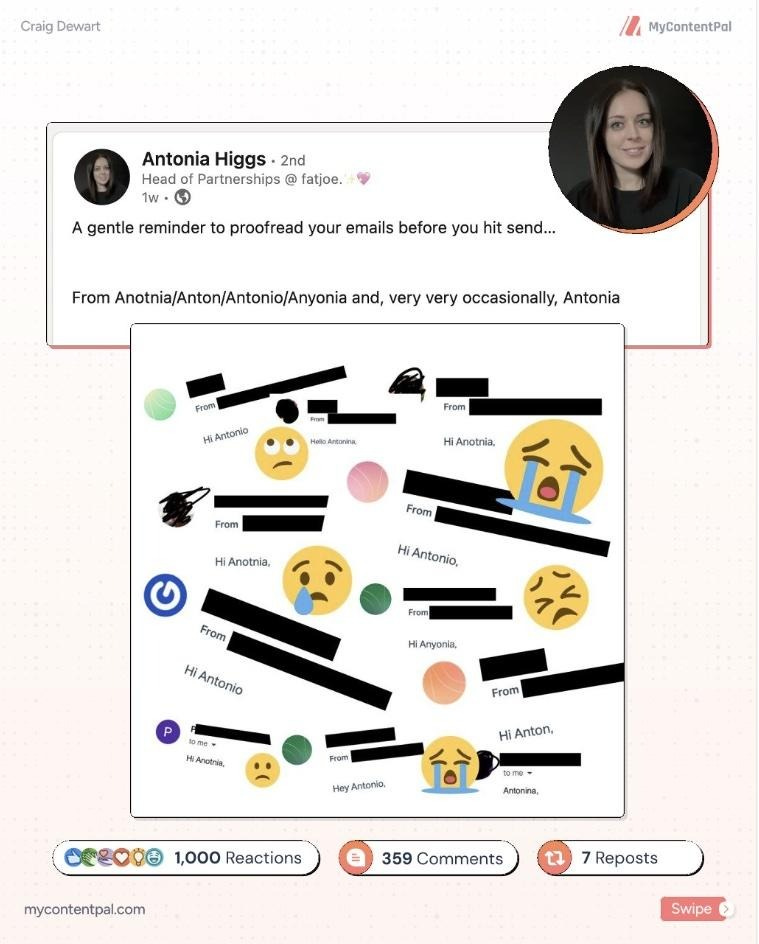
There’s a reason “POV: Marketing team meets Software Engineers” and “POV: Your boss thinks he’s Alex Hormozi” get millions of views.
It gives your audience something to relate to and identify with. It makes it easy for people to be like “that’s sooo me” and tag their fave colleague.
A 2024 study on parasocial relationships found that perceived authenticity and similarity build trust that directly affects purchase intention and brand credibility. People don’t just watch the interns for fun… they start trusting the brand through those characters.
People. Buy. From. People. Not. From. Chat. G. P. T.
Psych 101: The Holy Trinity of Fun B2B
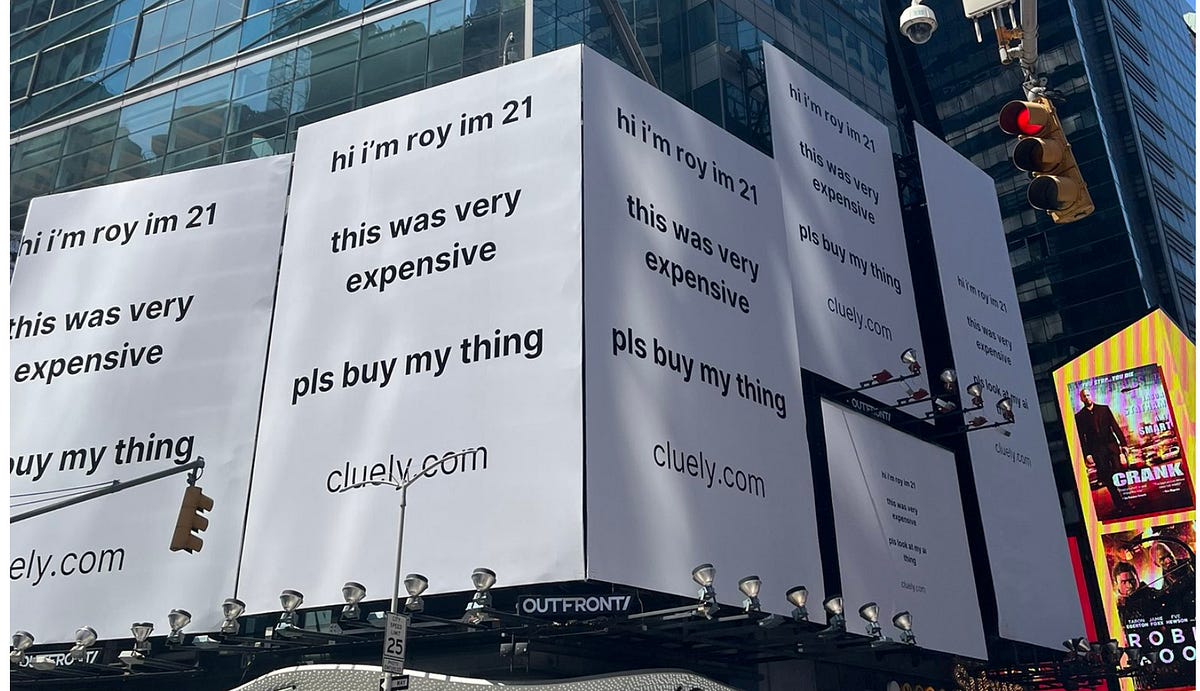
Final Boss 1: The Pattern Interrupt
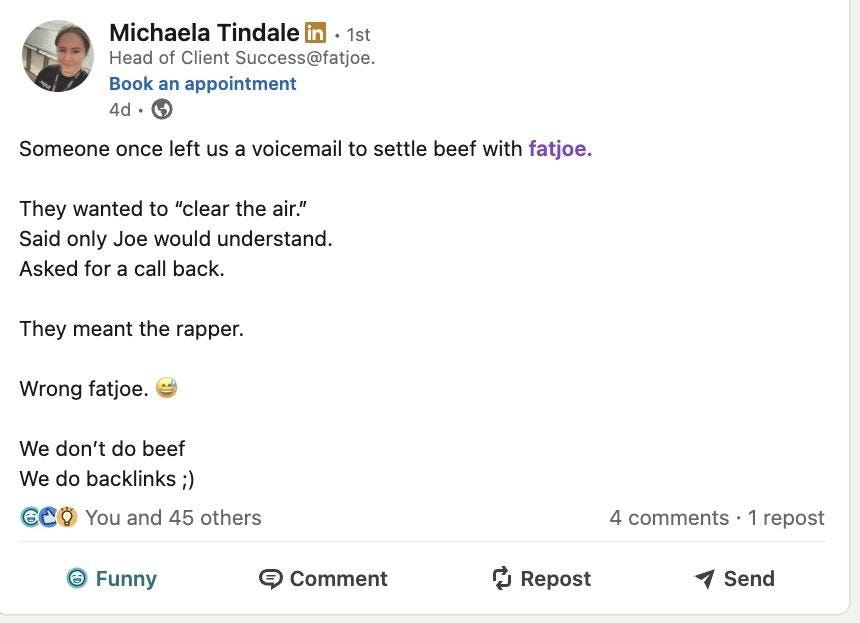
Humans tune out consistent stimuli. We only focus when something unexpected happens. Fun acts as a biological alertness trigger. It breaks the predictive loop your audience’s brain is running.
This doesn’t mean you need to be a comedian. It means your content needs to violate expectations in some small, delightful way. A fintech company talking about spreadsheet anxiety in a soap opera format. A consultant who opens a case study with a disaster story instead of a success metric.
Aim for “I didn’t expect that” over “hilarious”.
Proof LI froths for this: Instagram’s three key distribution signals are watch time (did it hold attention?), likes (quick positive evaluation), and sends/shares (the closest behavioral proxy to word-of-mouth). Pattern interrupts boost all three.
Final Boss 2: The Arousal-Sharing Loop
Berger’s research proves that high-arousal emotions - whether positive (amusement, awe) or negative (anger, anxiety) - physically activate your nervous system. And when you’re activated, you share. Sadness, by contrast, actually suppresses sharing - sad articles were 16% less likely to make the New York Times most-emailed list.
B2B guys - informative is OUT. Being felt is IN.
Teaching + feeling = virality. Teaching alone = 9 likes.
Final Boss 3: The Identifiable Person Effect
People care about individuals, not abstractions. We donate more to one named child than to “millions affected.” The same principle applies to B2B.
When Ramp made their campaign about “Brian” (the actor playing CFO), they weren’t selling software. They were telling a story about a person.
When Kinso posts videos of their interns, they’re not marketing a product. They’re making you care about characters.
Recurring characters create parasocial familiarity. Your audience starts feeling like they know your team. And people buy from people they know. They scroll past logos.
The Fun Framework: How To Actually Do This
Step 1: Find the shared frustration. Every industry has pain points everyone feels but nobody’s brave enough to post about. The meeting that should’ve been an email. The approval process that takes 47 days. The CRM no one uses. These are your raw materials.
Step 2: Exaggerate it just enough. Push the frustration 10% past reality. Not into absurdity… just past the line where people go “okay, that’s too real.” Start with something that catches attention (the exaggeration), land on something true (the insight). That’s the “Huh? to Aha!” effect.
Step 3: Deliver the insight underneath. You need fun MIXED WITH insight. Ramp’s glass box stunt was funny yeah, but it also showed that manual expense reporting is painfully slow compared to their product. The teaching was embedded in the experience, not bolted on as a caption.
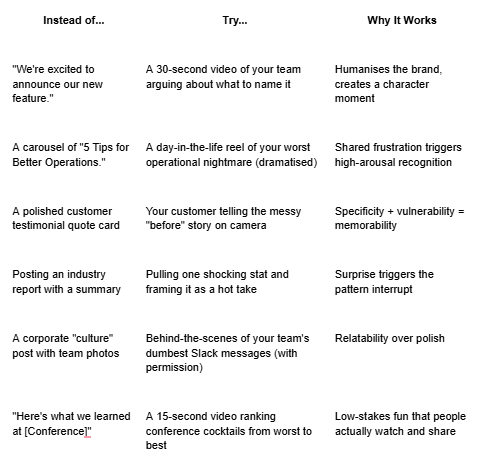
Before & After: Boring B2B → Fun B2B
The Fear You Need To Get Over
Yeah, I get it. You’re worried it’ll flop and you’ll be embarrassed. Or you’re worried people will take you and your company for a joke.
But take it from me. Because this silly lil post performed better than all the educational content I posted that month. Combined.
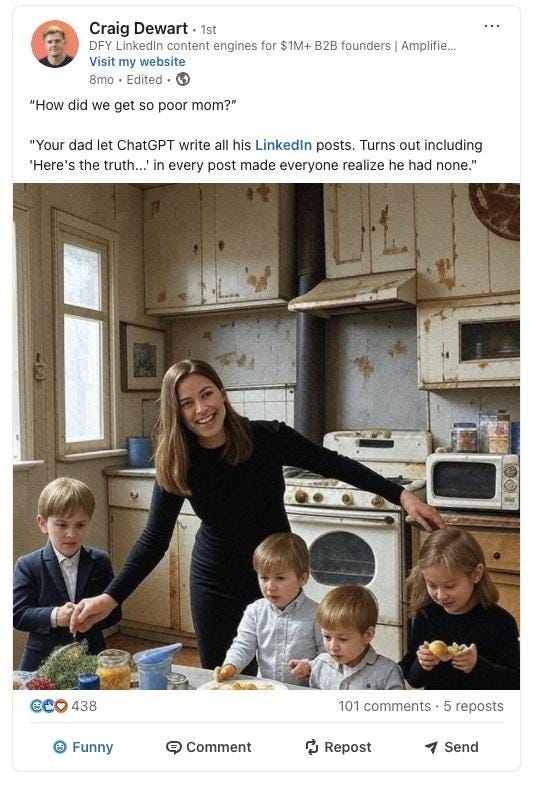
Let me kill your ego quick: no one’s thinking about your brand as much as you think they are. It’s more risky to be invisible than ‘seem unprofessional’.
The person reading your content at 8:47 AM is the same person watching comedy clips at 8:48 AM. They don’t have two brains. They have one. And that brain rewards surprise, punishes predictability, and shares what makes it feel something.
The One Minute Test
Before you click post next time, ask:
“Would I stop my daily doomscroll for this?”
If the answer’s no, you already know what to do.
- Craig
PS - next week I’m serving you the specific content formats that work for fun B2B (memes, short-form video, character-driven series etc etc). If you want to see how to apply this to your brand, you need this.
Have fun!