


Running an agency while trying to create content for my brand used to take serious effort. Even though it’s one of the highest ROI activities for me, finding the mental bandwidth was a real challenge some days until I figured out ways to make it work.
As a B2B founder, you’re pulled in so many directions. You’re dealing with client work, operations, hiring decisions, and then you’re supposed to squeeze in time to be creative and insightful on top of all that.
Yet some people pull it off, and I’ve seen it work firsthand.
Cold IQ built most of their pipeline through content and hit meaningful revenue fast.
Sam Dunning, the guy behind Breaking B2B, scaled past six figures with only two people while still running a YouTube channel and posting on LinkedIn daily.
Max Sturtevant scaled his email marketing agency past $300k+ p/m and writes 60+ posts per week.
So how do they do it?
Before I break it down in this newsletter, let me tackle the biggest objection first.
You’re probably thinking they must have ghostwriters and huge teams handling everything. And while I’m a big advocate of ghostwriting, the reality is that there are people like Max and Sam who have done it all by themselves. I’m pretty sure the Cold IQ guys started the same way and only scaled their team later.
Here’s Max’s actual posting schedule that he maintained while building his agency:
YouTube video once per week
Newsletters 3x per week
LinkedIn post once per weekday
Instagram carousel post once per day
Instagram short form once per day
Tweets three times per day + three retweets from past tweets
My take on it?
With the right routine / workflow, it’s totally possible.
Plus…
If you’re a solo consultant pulling in under $100k per year or running an agency under $500k, I really don’t think you should outsource this yet. Your content represents your thinking made public, and outsourcing your thinking too early can slow your growth in ways you won’t spot right away.
Hold off until your worldview is so concrete that a writer is just documenting what you already believe, rather than trying to invent a personality for you.
Now, let me show you exactly how to build a system that actually works without burning out.
🧠The Brain Science Behind Content Creation
First thing you need to understand is how your brain works when creating content, because most founders get this completely wrong.
Writing and ideation use completely different neural networks in your brain.
When you’re brainstorming and coming up with ideas, you’re using what scientists call the default mode network. This is the same part that becomes active when you’re in the shower or taking a walk and suddenly get hit with great ideas.
But when you’re actually writing and structuring your thoughts, you switch to your executive control network. This handles focus, logic, organization, and problem-solving.
Most founders try to do both simultaneously. They open a blank document expecting ideas to flow while they’re editing and structuring everything at the same time.
This is why your drafts folder is full of half-finished posts with a few bullet points and paragraphs you rewrote five times before giving up. You’re forcing your brain to create and analyze at the exact same time, which kills all your momentum.
The solution is much simpler than you think. Separate your thinking time from your writing time completely.
Build Your Schedule Around Your Brain
When I write heavily for several hours, the front of my brain literally starts aching. I get tired eyes, foggy thinking, and hit a total cognitive wall.
For the longest time, I thought this was burnout, but after researching it, I realized it’s just your prefrontal cortex hitting its daily limits.
This part of your brain handles focus, language, and executive control. It’s the same area that gets completely taxed when you’re deep in strategic thinking or handling complex client work.
So I completely restructured my schedule to work with my brain’s natural rhythms instead of fighting them constantly.
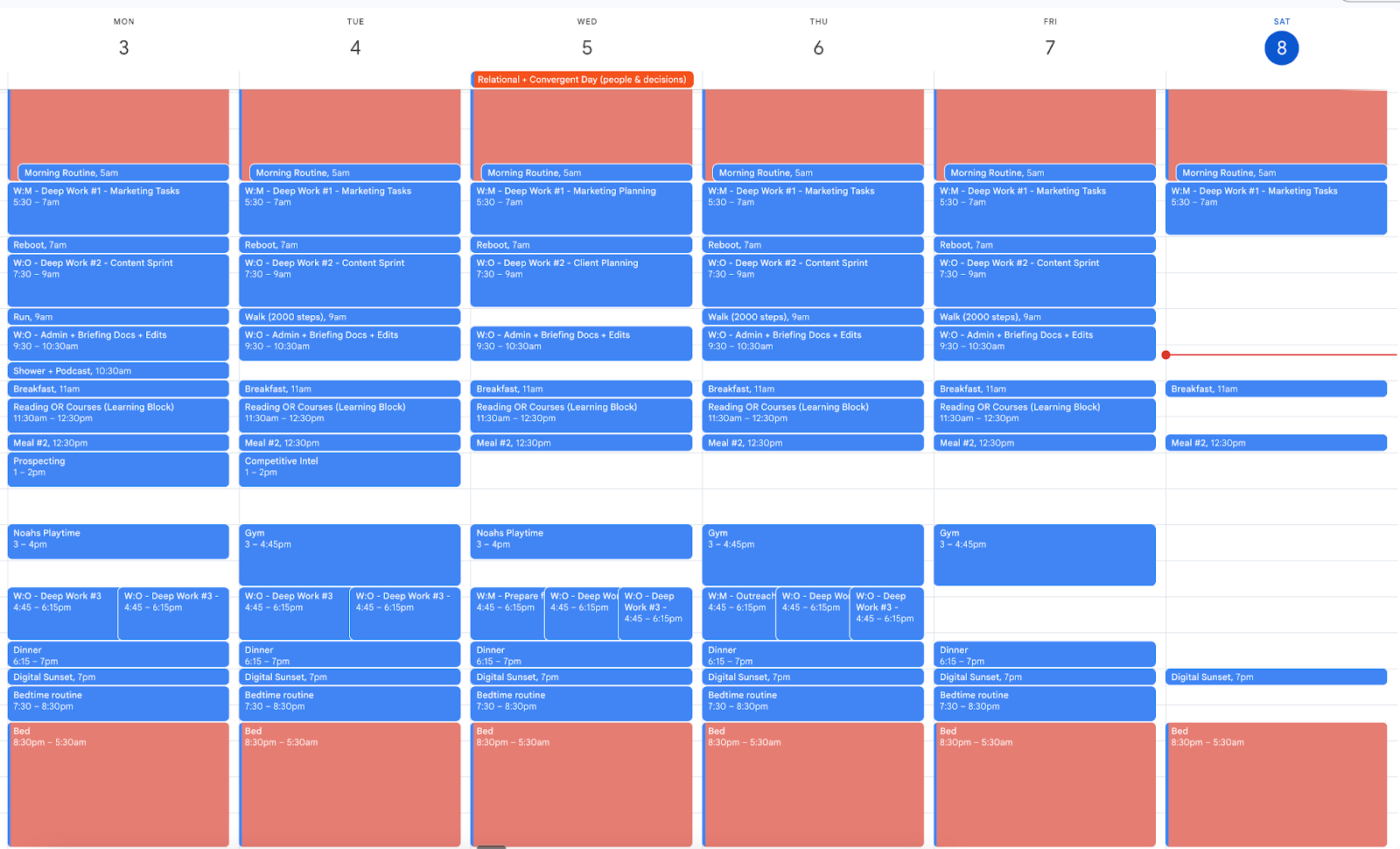
I realize this schedule is a lot. But with a 10-month-old at home and trying to push through the messy middle of growing this business, this level of structure is what keeps me productive, at least until things settle a bit more.
Monday and Tuesday became my heavy writing days.
Wednesday turned into my relational day, where I handle meetings, calls, and conversations but avoid any deep focus work.
Thursday and Friday, I return to writing feeling fresh and clear-headed again.
Wednesday gives my prefrontal cortex a complete break so I can hit the end of the week with creative energy again. It also means I’m not constantly context-switching and taxing myself with different types of cognitive work throughout each day.
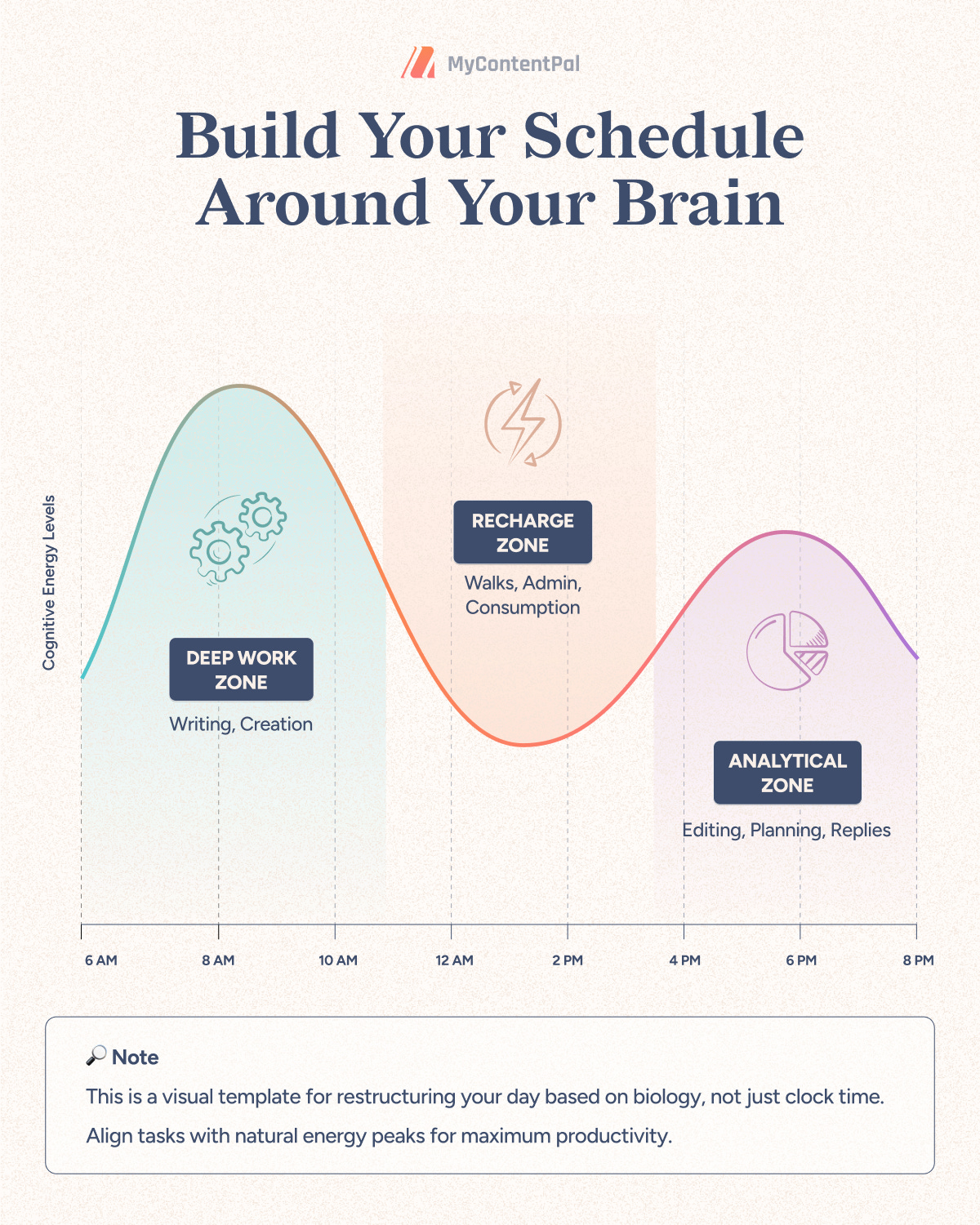
This schedule follows natural circadian rhythms instead of working against them. Most people experience two distinct energy peaks during each day:
One happens in the morning and works best for creative and deep work.
The second comes in late afternoon or early evening and handles analytical work better.
I schedule my writing during morning peaks when my brain feels naturally alert. Then I use afternoon energy dips for recharging activities like walking, scrolling LinkedIn for inspiration, or just letting my mind wander and think.
I also work in 90-minute writing sprints followed by short breaks. Each break resets my attention span and gives my brain time to recover before the next session.
✅ What to do now:
Track your energy levels each day for one full week and notice when you feel most creative versus when you completely crash. Then restructure your schedule to reserve those peak creative times for content production.
The difference in output when you write during an energy peak versus when you’re drained is massive. You’ll produce more quality work in 1 peak hour than 3 hours when you’re running on empty.
And don’t feel guilty about using mid-day for a recharge activity, whether that’s exercise, walk, or a quick nap. Think of it as refueling your creative engine so it can run at full capacity.
TIP: There’s an app called Rise that helps you track and understand your circadian rhythm. It shows when your natural energy peaks and crashes happen throughout the day, which makes scheduling a lot easier.
Fix the Real Objection
Most founders don’t actually hate writing. They hate the feeling of complete incompetence that comes with staring at a blank page for 30 minutes.
There’s this widespread myth that content creation should feel “easy” somehow. It’s simple in concept, but mastering it demands serious focus, clarity, and deep thinking that most of us rarely make dedicated time for.
The default response becomes “I’m just not good at writing” or “I don’t have anything interesting to say.”
But writing is really just clear thinking made visible on a page. The clearer your thinking gets, the better your writing becomes naturally.
Here’s why you shouldn’t outsource this work yet. You’ll struggle to find any ghostwriter who can think at the caliber you need them to. Plus, you’re missing the real value that comes from the writing process itself.
Writing forces you to think deeply about your business, your customers, and your industry in ways that nothing else does.
When I write about ideation processes and content systems, I’m actually working through real problems in my own business. It makes my service offerings better and helps me understand my customers at a much deeper level, which dramatically improves my marketing and sales conversations.
Outsourcing that thinking process too early means losing all those business insights.
For More Reading: How fixing your bottleneck = unlimited content ideas
🕳️ Pitfalls to beware of:
Expecting immediate expertise: Writing well takes practice, just like any other business skill. So, give yourself permission to be bad at first.
Perfectionism paralysis: Publishing imperfect content that helps your audience beats perfect content that never gets published.
The Ideation System That Actually Works
You can be a complete expert in your field and still struggle with generating content ideas. If you sit down to write without knowing what to cover, you’ll spend the entire session staring at blank documents while frustration builds and momentum dies.
The solution is making the starting process easier by doing ideation work before your writing sessions even begin.
This is how I set myself up for success:
Idea Capture System
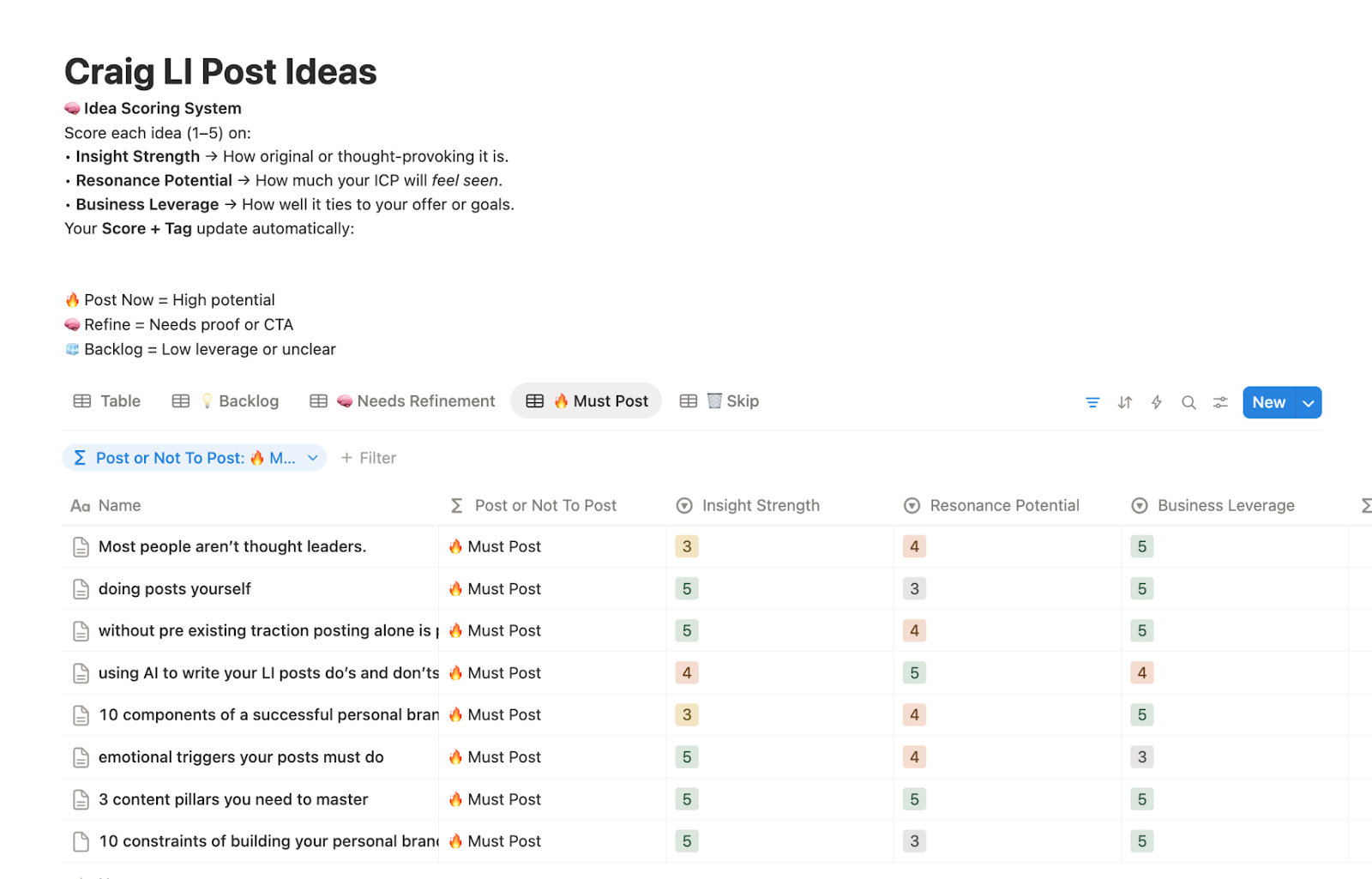
I use a simple Notion document for storing and developing ideas over time.
When I get a rough concept like “building resilient systems,” I might not have enough material to write about it immediately. So I’ll spend the next few days or weeks thinking about this concept and progressively adding references, examples, personal stories, and different angles to explore.
I do most of this ideation work while I’m prospecting for new clients or going for walks. Your brain makes unexpected connections when you’re doing other activities.
Environment setup
Before writing sessions, I completely clear my environment of distractions. Phone gets turned off, Slack stays closed, and I find a quiet space where I can think clearly.
Writing requires mental stillness, and chaotic environments produce chaotic thoughts.
Tools and resources
I also prepare all my tools and resources before starting any writing. GPTs, research documents, and reference materials get organized beforehand so I can stay in creative flow instead of context switching to hunt for information.
Voice-to-text tools like Wispr Flow can dramatically increase your output because speaking often flows more naturally than typing.
Creative incubation
Most of my best ideas actually come when I’m away from my desk completely. While prospecting, walking, or working out, my brain connects dots subconsciously because that’s when your default mode network becomes most active.
TIP: Schedule in active recovery. It will do wonders for your health but also free up space for your creativity to come back to life.
✅ What to do now:
Set up your ideation system this week. Create a simple document where you can capture and develop ideas over time. Start carrying a notebook or use voice memos to capture thoughts when you’re away from your computer.
You can download the capture system here:
[ Link to My Content Pal Resource ]
Develop Your Content Taste
Knowing what to create matters just as much as creating consistently. You can have perfect systems and solid writing habits but still publish content that completely fails to connect with your audience.
That’s why developing taste becomes so important.
Taste is what helps you separate decent ideas from truly great ones. It’s that invisible quality that makes people stop scrolling because something just feels right and worth paying attention to.
Taste isn’t something you’re born with. It’s something you deliberately train and develop over time.
I train mine during afternoon energy dips when I’m going to be scrolling social media anyway. Instead of mindless consumption, I make it intentional and educational.
I’ll analyze DTC Instagram ads or YouTube thumbnails and ask myself:
Why did this particular piece catch my attention?
What emotion does this headline trigger in me?
How could I adapt this approach for LinkedIn posts or newsletter content?
You start noticing patterns in pacing, hooks, visual design, and tone of voice. Then you borrow the underlying principle without copying the actual post.
For example, I might see a brilliant DTC ad that uses identity or humor to connect with their audience, then think about how that same psychological principle would work for B2B founders. That observation becomes my next content idea.
The goal is to change how you consume content so you’re learning instead of just killing time.
✅ What to do now:
Transform your content consumption into content education. Instead of mindless scrolling, start analyzing what catches your attention and why. Keep a running list of patterns and principles you can adapt for your own content.
🕳️ Pitfalls to beware of:
Copying instead of adapting: Take the principle behind what works, not the exact execution.
Analysis paralysis: Study patterns, but don’t let analysis replace actually creating content.
The Power of Batching
Once you separate ideation from writing, the next step is eliminating context switching across different content formats.
Most people wake up and try to “make something” that day. Maybe a LinkedIn post, a video, or a carousel, depending on what feels easiest in the moment.
That approach leads to inconsistency and creative fatigue because you’re constantly switching between different types of creative work.
Instead, I batch content either by medium or by core idea.
Medium batching
When I’m batching by medium, I stay locked into one format for extended periods.
For example, I’ll spend an entire day creating all my carousels for the next month, handling the writing, design, and scheduling in one focused session. Or I’ll dedicate a full day to filming short-form videos, shooting multiple scripts in different outfits and setups so I can distribute clips over several weeks.
Idea batching
Sometimes I switch to batching by idea instead. That’s where I go deep on one concept and repurpose it across every channel I use.
I’ll take a single insight and turn it into a newsletter, short-form video script, LinkedIn post, and maybe even a lead magnet, all during the same creative session.
Both approaches eliminate what I call creative startup friction.
You stay in the same mental flow, protect your cognitive energy, and build systems that let your creative output scale without burning you out.
✅ What to do now:
Choose one batching approach to test this week. Either batch by content format (spend one day creating multiple pieces of the same type) or batch by idea (take one concept and create multiple formats from it).
Turn One Idea Into Multiple Posts
Most founders don’t burn out because they create too much content. They burn out because they start from scratch every single time.
They treat every post like a brand new project instead of realizing that one solid idea can stretch much further than they think.
A truly good idea deserves 5 to 10+ different angles and formats.
If you write a post that really connects with your audience, don’t just move on to something completely different. Go deeper with that same concept.
Rewrite it with a new angle.
Turn it into a detailed X thread.
Record a short video explaining the personal story behind it.
Design a carousel that breaks down the concept visually.
Use it as the foundation for your next newsletter, then pull quotes from that newsletter for Twitter and LinkedIn posts.
That’s how you get real leverage from your creative work.
Founders who produce huge volumes of content aren’t writing 50 completely new ideas every week. They’re taking 5 great ideas and distributing them across 10 different formats and platforms.
They’re also constantly listening to their audience. Comments, direct messages, and questions from readers become new content ideas. Every interaction provides a signal about what your audience actually cares about. Every question becomes a writing prompt.
When someone asks, “How do you find time to write so much?” that becomes next week’s post.
When someone challenges your perspective, that becomes your next response video.
When someone shares your post with a comment like “this really hit home for me,” you screenshot that social proof and repackage it.
This approach solves one of the biggest content creation problems most founders face: running out of things to say.
When you keep revisiting and expanding on your strongest concepts, you’re creating more content, yes, but also developing a deeper understanding of your market, your customers, and your unique value proposition. And that’s always good for business.
✅ What to do now:
Start treating your best-performing content as content libraries instead of one-off posts. When something resonates, create a systematic process for extending that idea across multiple formats and platforms.
The Waterfall System
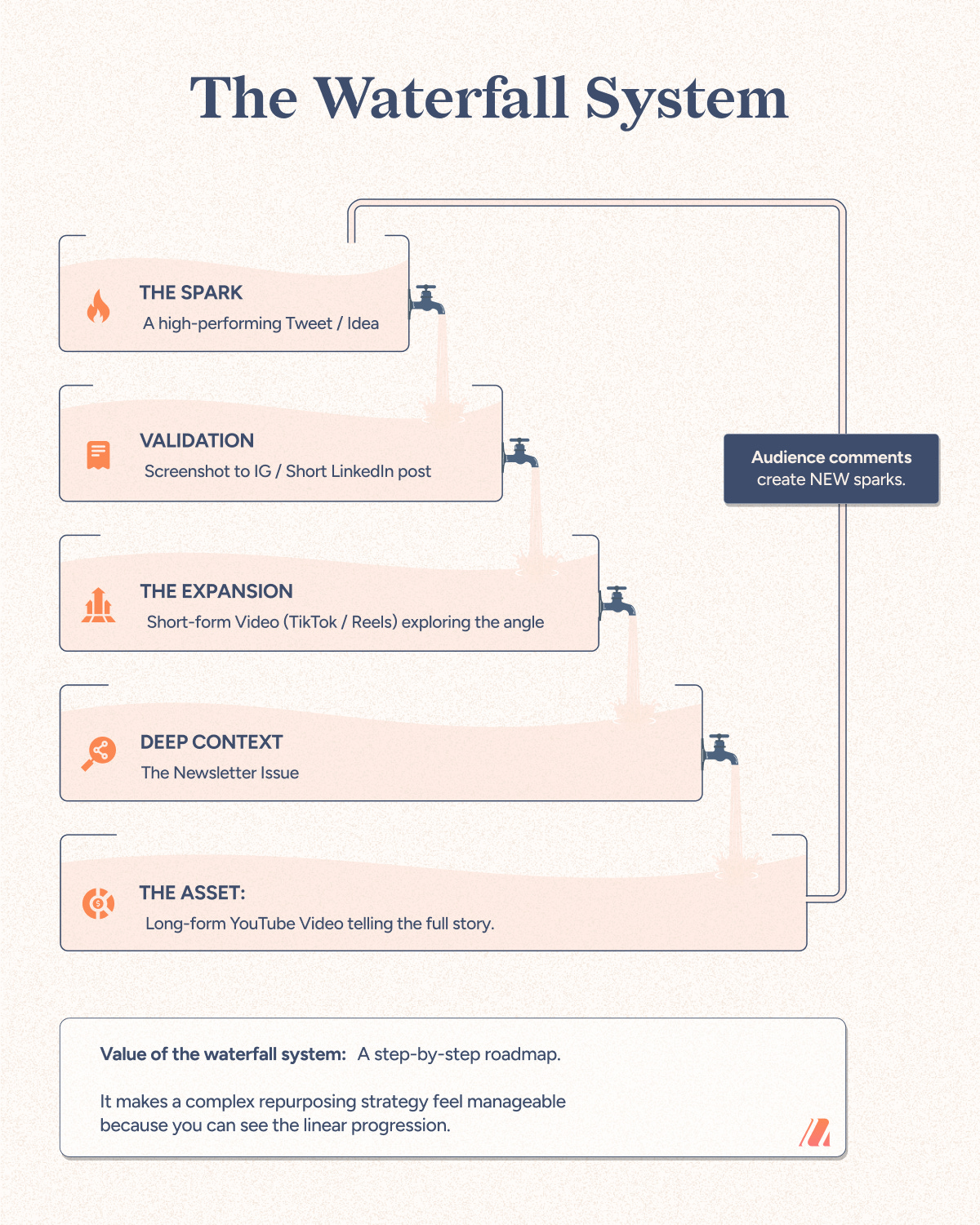
Let’s take this leverage concept even further with what Matt Gray calls the Waterfall System.
It’s about repurposing one core idea across multiple formats and platforms instead of constantly generating new material.
Each format should flow naturally into the next one.
Here’s what that looks like in practice:
He writes a single tweet that performs well with his audience. This is the initial spark.
Then he screenshots that tweet and posts it on Instagram.
He records a short-form video discussing the same topic from a slightly different angle.
He includes a version of that insight in his next newsletter, providing deeper context and background.
Then he takes the full concept and expands it into a long-form YouTube video. The video tells the complete story with personal examples.
Same core idea.
Five different formats.
Five separate platforms.
Five touchpoints with his audience.
That’s the Waterfall System.
What’s brilliant about this approach is that you’re not diluting your ideas by spreading them around.
You’re actually deepening them by giving people multiple ways to consume the same concept based on their preferred medium and attention span.
Matt Gray popularized this system, and it’s one of the smartest frameworks I’ve seen for founders who want to scale content without burning out.
✅ What to do now:
Design your own waterfall system. Start with one platform where you’re most comfortable, then map out how you’ll adapt that same content for 2-3 other formats on different platforms.
🕳️ Pitfalls to beware of:
Exact replication: Adapt the core idea for each platform instead of copy-pasting identical content.
Overwhelming yourself: Start with 2-3 formats before expanding to more complex waterfall systems.
How to Fuel Your Brain for Better Creative Output
Mental stamina isn’t purely cognitive. It’s also chemical, and most founders completely ignore this part.
When your blood glucose crashes, your focus and creativity crash right along with it. This is why you might feel sharp in the morning but struggle to form coherent thoughts by 3 PM.
I’ve learned to work with these natural fluctuations. I delay my first coffee for about 90 minutes after waking up because it helps keep my natural cortisol rhythm stable throughout the day.
Then I start each morning with small amounts of fruit like blueberries, grapes, or strawberries. This gives me slow-release glucose without the spike and crash that comes from processed foods.
I also don’t consume any processed carbohydrates or sugar-loaded snacks during my writing sessions. Just clean energy sources and lots of water throughout the day.
Sleep quality is another thing that directly impacts creative output.
When you’re sleep-deprived, your brain has trouble making the unexpected connections that lead to interesting insights. This is why I aim for 7-8 hours and try to keep consistent sleep and wake times, even on weekends.
Your brain is an organ that needs proper fuel to function at its best. Feed it correctly and give it adequate rest, and your creative output will follow naturally.
Ready to Get Started?
The founders who scale past six figures while maintaining consistent content have systems that work with their brain and body instead of fighting against their natural rhythms.
I recommend picking one thing from this newsletter and testing it for a few weeks.
Don’t try to overhaul your entire approach on Monday morning. Maybe batch your ideation sessions or redesign your weekly schedule around your energy peaks. Once that becomes a habit, add the next piece.
Your content creation routine should not be a sprint that you can only maintain for a few weeks before burning out completely. It should be sustainable over months and years, and make running your business easier, not harder.
So, start small, and most importantly, stay consistent.