

You’ve been posting for months. The likes are… fine. The comments are halfway decent. But the inbound just isn’t there.
So you do what most people do.
You start by rewriting your hook. Then you test a different format. Hell, you may even hire someone to punch it up a little for you.
But nothing you do is going to move the needle until you realise it’s time for serious change. And by that, I mean doing something structurally different.
That’s where a little something I like to call “pairings” comes in.
What Pairings Are (and Why They Matter)
Every time your audience sees your name, their brain is making associations with you.
They aren’t doing it consciously. It happens automatically through constant exposure.
The idea that they arrive at over time is totally dependent on what you’ve paired yourself with.
Alex Hormozi describes it as the bouquet.
In this analogy, flowers are associations people have made with you, and you’re the person holding them.
These associations come from things like:
What you post about
Who you reference
How your profile looks
The language you repeat
The environments you’re seen in
If you manage to tie the right flowers together (consistently), your audience’s brain learns a shortcut.
Your bouquet isn’t going to get better by adding more flowers, though. You’ve got to start pruning the wrong ones instead.
I’ve come across 7 pairing types in the strongest personal brands on LinkedIn. And I learned that the people who are converting inbound are stacking six to eight of them, deliberately.
1. Identity Pairing
This is all about pairing yourself with who your audience already believes they are.
Labels take care of this pretty quickly.
The right phrase creates a sort of belonging before they even read your posts all the way through.
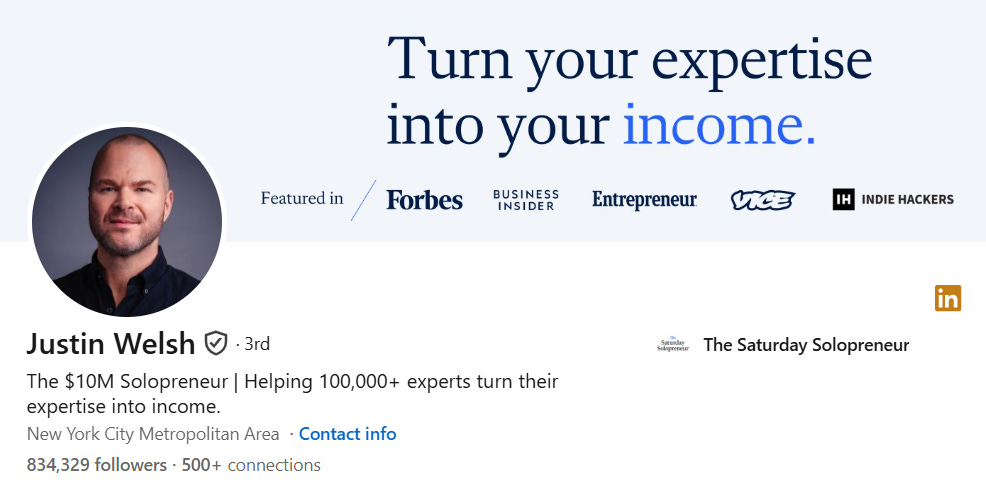
“Solopreneur”
That’s it. That’s all he used.
The idea of a “solopreneur” wasn’t even a thing when Justin Welsh started building his brand. He adopted it as an identity signal before the word had any mainstream recognition.
Because of that, his ICP (young entrepreneurs figuring things outs) saw themselves in his content.
How to achieve it
Write down exactly who your ICP believes they are, and think out of the box.
Ignore their job titles. Think about a label that they would want to use.
Then, make that label visible in your bio and the language you repeat.
You’re not describing yourself here. Instead, you’re letting them recognise themselves in you.
2. Aspirational Identity Pairing
If you shift focus a little, you can pair yourself with who your audience wants to become.
In my opinion, this is the more powerful version.
With this pairing, you’re showing your ICP who they’re actively trying to be in the future.
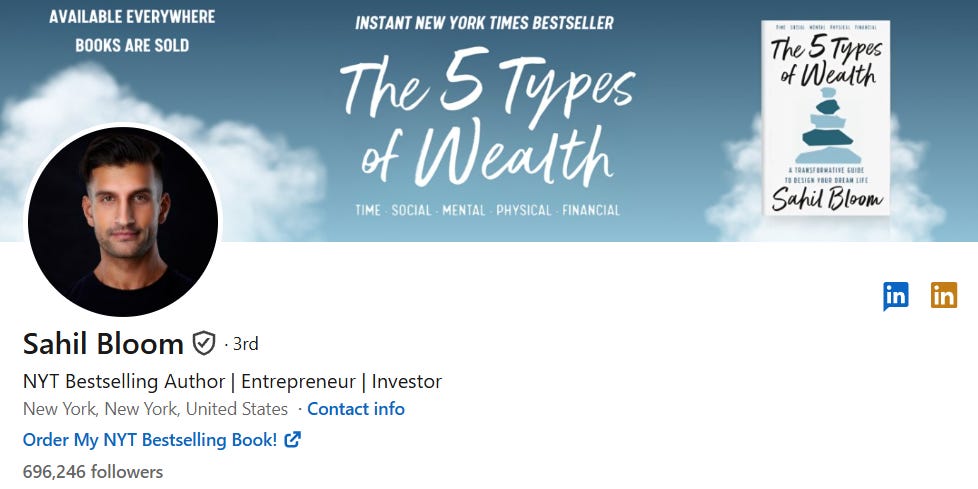
Sahil’s audience is made up of high achievers who want to leave their day jobs behind (on their terms).
He left his finance career on Wall Street and documented his transition into his dream life in real time. And, rather than telling people it was possible, he became the proof himself.
How to achieve it
You need to start being specific about the future version of your ICP.
“Successful” ❌
“SaaS CEO who closed $500k from inbound alone last quarter” ✅
Before you can really make the transition, you need to ask yourself:
Does your content prove that version of life is achievable?
If it doesn’t, that’s the gap you need to fill.
3. Authority Halo Pairing
Imagine borrowing someone’s status and using that to build your own. That’s exactly what this is.
You don’t need to actually know someone to do this, either.
If you’ve been on LinkedIn for more than a day, you’ll have seen the thousands of “What Hormozi’s pricing model taught me” posts.
The people who post these breakdowns don’t know Alex Hormozi personally. They just had something to say about his content (and benefited from his ICP’s trust in him).
Let’s use Hormozi as the example, though…
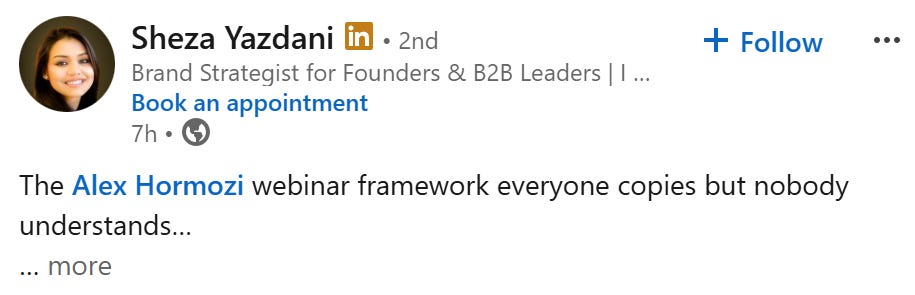

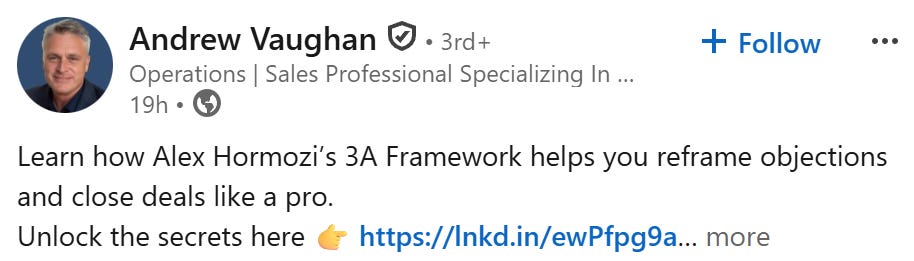
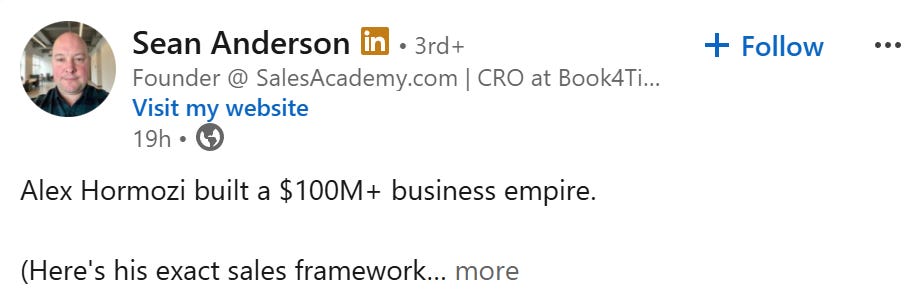
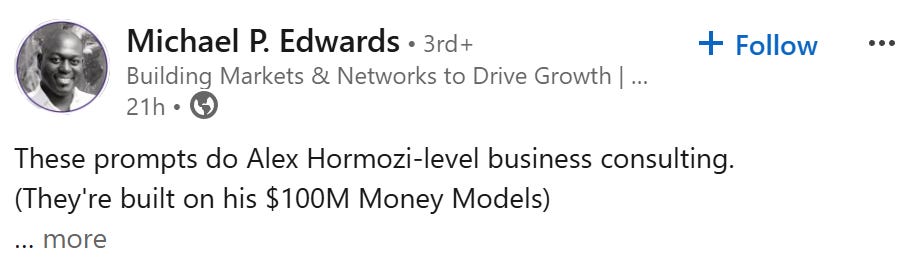
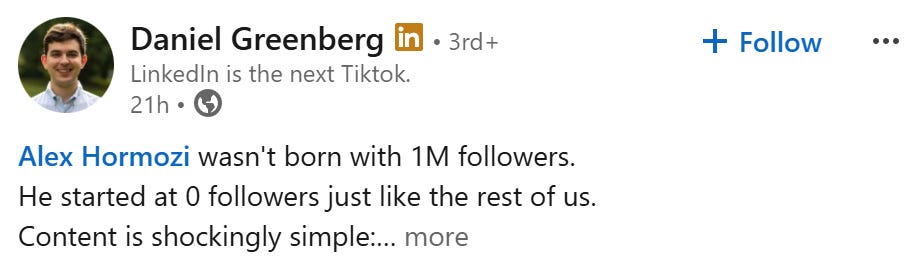
I found all of these accounts namedropping Alex Hormozi in the last 24 hours alone.
And I can bet that they got some serious credibility just from talking about his frameworks.
How to achieve it
Find someone your ICP already trusts
Break down their framework publicly or analyse a decision they made
Pick out a few more people
Disagree with their takes and explain why
Post your content
Use the status you gain to build your own trust
4. Environmental Pairing
The physical environments you’re seen in tell your audience a lot about your life.
Look at Matt Gray.
Almost everything he posts ties back to the idea of being out in nature.
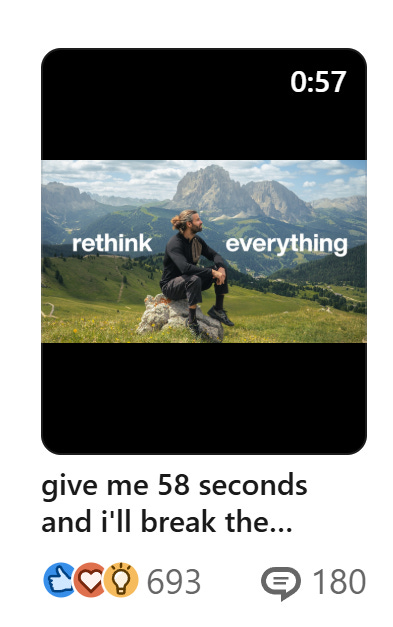
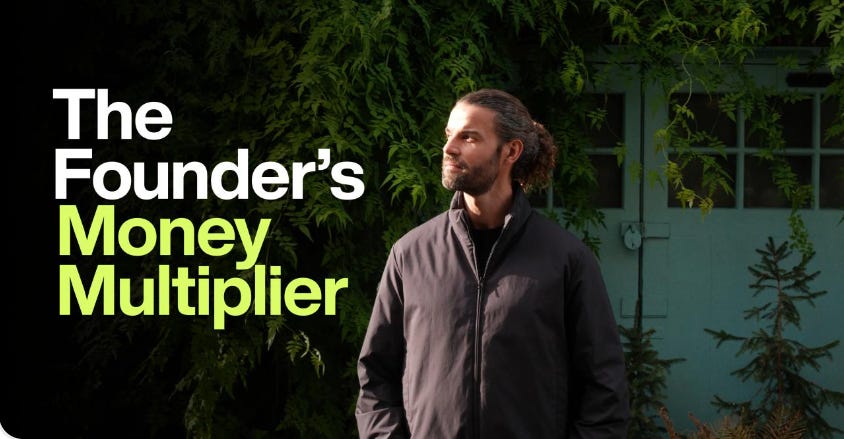
Just by seeing those images, your brain has made the association he’s learned how to escape the chaos. He isn’t sitting behind a desk. He has freedom.
If that’s how powerful an image can be, imagine what that would train your brain to believe over months of seeing his content.
How to achieve it
Look at the last 10 photos or videos you’ve posted. What does the background condition your audience to feel?
You want to pick a consistent environment that shows (not tells) your ICP the life your work can produce and start posting from there.
After all, a picture’s worth a thousand words, right?
5. Insider Truth Pairing
I want to be known for saying the thing that everyone thinks, but that nobody actually has the balls to say.
That’s one of my pairings. And I’m super intentional with it.
I want people to see me and think, “This guy gets it. This guy gets me.”
The most popular posts are usually opinions. People love rallying together for (or against) something.
This pairing is about the whispered frustrations of your ICP. It positions you as an insider, as someone who shares their pain and who can help them eliminate it.
Check out a post I wrote:

I’m calling out how my ICP feels. They don’t want to waste their lives behind a screen. They actually want to live.
How to achieve it
Start by writing down three things your ICP believes about their industry but would never admit to.
Pick the sharpest one and say it directly. Cut all the bullsh*t. Cut all the noise.
Then, write a post that vocalises what your ICP thinks at 11pm on a Sunday.
It’ll position you as the one honest person in the feed. And that’s a more sustainable position than being the best educator.
6. Behavioural Residue Pairing
You want to make your invisible wins visible.
Jonah Berger calls it behavioural residue. This turns your “I Voted” sticker from a private action into a public signal.
Your post about your midday walk does the same job.
It doesn’t say “I’ve made it”. It actually demonstrates it.

This post from Iman Gadzhi is about the cost of keeping up appearances, right?
Sure. If you want to look at the technicalities of it.
But what do you see? Look at the image he used. Expensive suit, nice car…
It shows off his success without him having to scream it. And his brand is super consistent.
The images of jets and penthouses he posts are deliberate residue for an audience that’s buying into a version of life.
How to achieve it
Make a mental note of what your ICP is ultimately buying into.
Do they want time freedom? Or are they after financial control?
Whatever it is, post a private moment that implies you’ve already achieved that outcome. Your ICP doesn’t want to see the work or the process behind it. They want to see the output.
7. Anti-Pairing (Strategic Pruning)
Let’s tie back to Alex Hormozi’s idea of the bouquet. Forget forming new pairings. You can make your existing pairings more impactful by refusing certain associations.
For instance, I watched tons of the creators on this list actively prune the content that didn’t fit their bouquet.
But one person in particular stuck out to me the most.
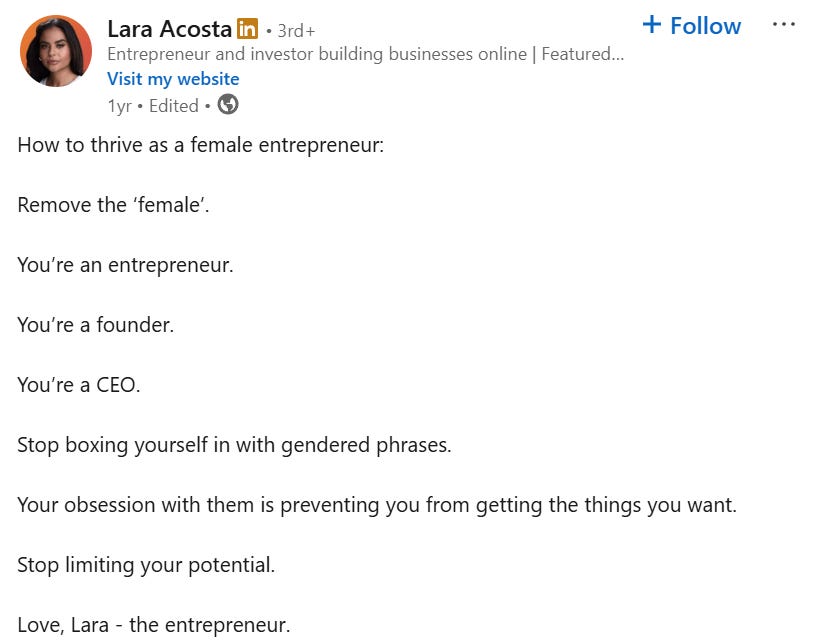
Instead of silently removing posts and trying to quietly remove the association of being a ‘female entrepreneur’, Lara Acosta cut ties with that pairing by telling her audience that’s what she was doing.
It was a bold move. But it worked.
Nobody associates her with her gender anymore. They think of her as an example of what hard work and determination can help you achieve.
How to achieve it
There are way too many founders who never prune their bouquet because dumping out content over and over again feels like progress.
Reality check: It’s not.
Go through your last 20 posts and mark anything that doesn’t directly support the identity you’re building.
Be brutal, because every off-brand post trains your audience to associate you with something you didn’t choose.
How the Strongest Brands Stack Their Pairings
All of the biggest brands I follow have around six to eight associations that they consistently and deliberately stack up.
Here are my top three:
Alex Hormozi: Discipline. Anti-pairing. Authority halo. Insider truths. Warrior archetype. Industrial aesthetic. Behavioural residue through restraint.
Matt Gray: Environmental. Aesthetic. Discipline. Aspirational identity. Anti-hustle insider truth. Outcome pairing through visible freedom.
Iman Gadzhi: Luxury aesthetic. Wealth outcome. Rebel archetype. Scarcity. Aspirational identity.
If you want to really sell your personal brand, it’s time to put your effort into doing the same thing.
- Craig